
Compare
How to compare skip tracing services.
Providers quote prices in different units, count hits in different ways, and hide costs in minimums and expiring credits. This page lists the criteria worth asking any skip tracing service about, and states where DataSkip stands on each one. Full rates are on the pricing page, and short answers live in the skip tracing FAQ.
Pay per hit vs pay per record vs subscription
Skip tracing pricing comes in three shapes. Pay per hit charges only when a record comes back with owner contact data. Pay per record charges for every row you submit, matched or not. Subscriptions charge a monthly fee, usually with credits. The unit price alone tells you little: a lower per-record price can cost more than a higher per-hit price once misses, minimums, and expired credits are counted.
| Criteria | DataSkip (pay per hit) | Typical pay per record | Typical subscription |
|---|---|---|---|
| What you pay for | 4¢ per matched hit | Every record, hit or miss | Monthly fee plus credits |
| Misses | Free, always | Billed like hits | Consume credits |
| Minimum order | None, single skips work | Often 50 to 100 records | Plan minimums by tier |
| Commitment | None, pay as you go | None | Monthly or annual |
| Unused balance | Never expires | Not applicable | Credits often expire |
What counts as a hit
A quoted hit rate means nothing until you know what counts as a hit. Ask whether a hit requires owner contact data or just any returned field, and whether relatives or associated people count toward the rate. At DataSkip, a hit is a record we successfully match with owner contact data: the owner's name along with available phones, emails, and mailing address. Typical lists see a 98.9% hit rate, and records that return nothing cost nothing.
What data comes back on a hit
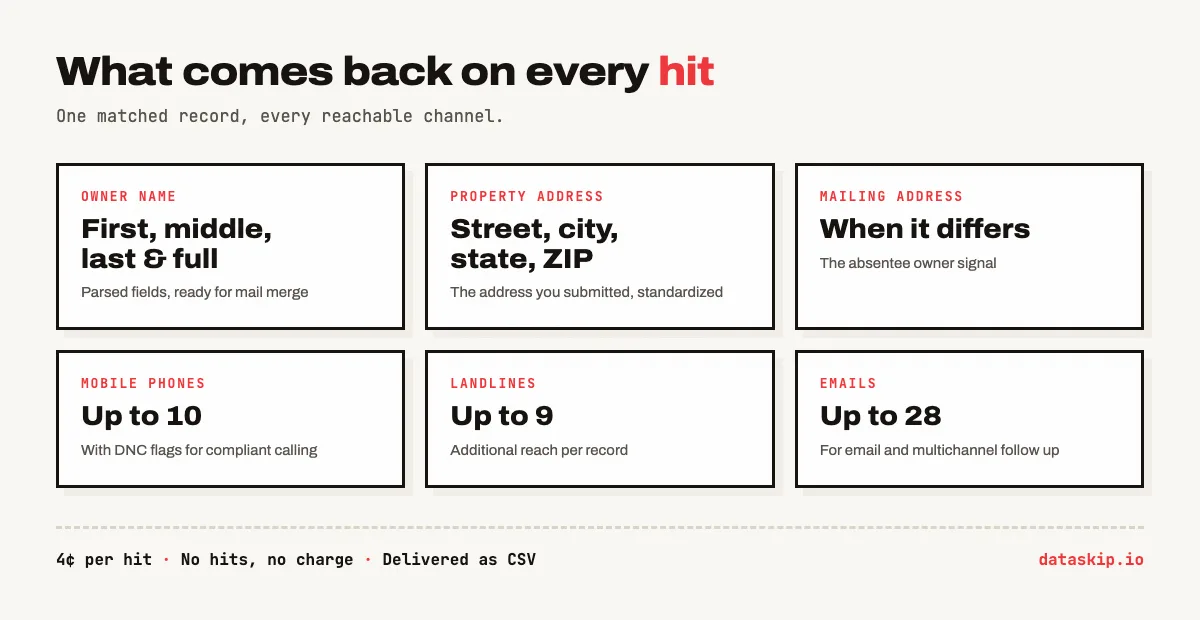
Per-hit prices are only comparable when the returned fields are comparable. Every DataSkip hit can include the owner's first, middle, last, and full name, the property address, the mailing address when it differs, up to 10 mobile phones, up to 9 landlines, and up to 28 emails. The same fields apply when you buy property owner data by the record. DataSkip is not a background check service: results cover ownership and contact information, not criminal, credit, or employment records.
Capacity and delivery: list size and formats
Check the ceiling before you commit: some services cap uploads or split big jobs into batches. DataSkip processes up to 250,000 records per skip trace in a single run, accepts Excel or CSV in, and returns a clean CSV. Developers can run the same skips through the skip tracing API, CLI, and SDK at the same flat rate.
Questions to ask any skip tracing provider
| Question | DataSkip's answer |
|---|---|
| Do misses cost anything? | No. No hits, no charge. |
| Is there a minimum order? | No. A single skip works. |
| How is a hit defined? | A matched record with owner contact data. |
| Do balances or credits expire? | No. Loaded balances never expire. |
| Is a subscription required? | No. Skip tracing is pay as you go. |
| Is there a volume discount? | On data buying only. Skips are a flat 4¢ at any size. |
| What is the maximum list size? | 250,000 records in one run. |
| What formats are supported? | Excel or CSV in, CSV out. |
All DataSkip figures above match the current rate sheet. Descriptions of other pricing models are general industry patterns, not claims about any specific company. Updated July 2026.
Compare done.
Start tracing.
4¢ per hit · No minimum order · No hits, no charge